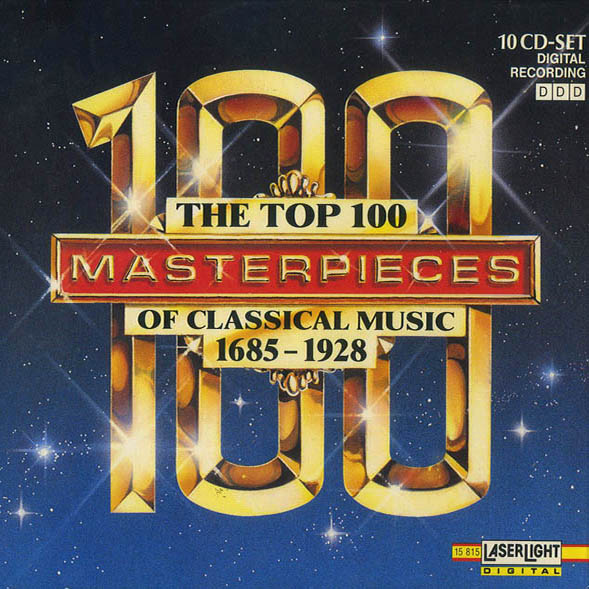
The Top 100 Masterpieces of Classical Music: 1685-1928

~ Release by Various Artists (see all versions of this release, 1 available)

Annotation

Individual cat#s run from 15 676 through 15 685.

Annotation last modified on 2015-02-26 04:59 UTC.

Tracklist

| |
1CD: Volume 1: The Top 10 of Classical Music 1685-1730
#TitleArtistRatingLength
1Toccata in D minor
organ and pipe organ:
Hannes Kästner (German organist and cembalist)
recording of:
Toccata in D minor (unspecified)
composer:
Johann Sebastian Bach (German Baroque period composer & musician)
recording of:
Toccata und Fuge d-Moll, BWV 565: I. Toccata
composer:
Johann Sebastian Bach (German Baroque period composer & musician)
part of:
Classic 100: Piano (2025) (number: 30)
part of:
Toccata und Fuge d-Moll, BWV 565 (Toccata and Fugue in D minor, BWV 565)
Johann Sebastian Bach32:47
2Canon in D
orchestra:
Neues Bachisches Collegium Musicum (New Bach Collegium Musicum) (from 1982 until 1984)
conductor:
Max Pommer (conductor) (from 1982 until 1984)
phonographic copyright (℗) by:
Delta Music GmbH (not for release label use! 1970–2007, succeeded in 2008 by Delta Music & Entertainment GmbH & Co. KG) (in 1985)
recorded at:
Paul-Gerhardt-Kirche in Leipzig, Sachsen (Saxony), Germany (from 1982 until 1984)
recording of:
Canon and Gigue in D major, P. 37, T. 337: I. Canon
composer:
Johann Pachelbel (composer)
part of:
Canon and Gigue in D major, P. 37, T. 337
Johann Pachelbel24:25
3Brandenburg Concerto No. 3 in G major, BWV 1048: I. Allegro
orchestra:
Deutsche Bachsolisten (German Bach Soloists)
conductor:
Helmut Winschermann (oboist/conductor)
recording of:
Brandenburgisches Konzert Nr. 3 G-Dur, BWV 1048: I. Allegro
composer:
Johann Sebastian Bach (German Baroque period composer & musician)
part of:
Brandenburgisches Konzert Nr. 3 G-Dur, BWV 1048 (Brandenburg Concerto No. 3 in G major, BWV 1048)
part of:
Brandenburgisches Konzert Nr. 3 G-Dur, BWV 1048 (Brandenburg Concerto No. 3 in G major, BWV 1048, Hillborg version with new 2nd mvt)
Johann Sebastian Bach35:34
4Water Music, Suite No. 2 in D
recording of:
Water Music Suite no. 2 in D major, HWV 349
composer:
George Frideric Handel (German‐British baroque composer) (in 1717)
part of:
Händel-Werke-Verzeichnis (number: HWV 349)
part of:
Water Music, HWV 348–350
Georg Friedrich Händel39:41
5Trumpet Tune and Air
brass:
Blechbläserensemble Ludwig Güttler (Ludwig Güttler Brass Ensemble)
performer:
Blechbläserensemble Ludwig Güttler (Ludwig Güttler Brass Ensemble)
recording of:
Trumpet Tune and Air
composer:
Henry Purcell (Baroque composer)
medley including a recording of:
Trumpet Tune in D (from The Island Princess, erroneously attributed to Henry Purcell)
composer:
Jeremiah Clarke (English baroque composer and organist)
previously attributed to:
Henry Purcell (Baroque composer)
Henry Purcell32:57
6Orchestral Suite No. 3 in D major, BWV 1068: II. Air
timpani:
Ralph Peinkofer (percussionist)
trumpet:
Wolfgang Basch Trumpet Ensemble
violin:
Wolfgang Hock
orchestra:
Deutsche Bachsolisten (German Bach Soloists)
conductor:
Helmut Winschermann (oboist/conductor)
recording of:
Orchestersuite Nr. 3 D-Dur, BWV 1068: II. Air (Orchestral Suite no. 3 in D major, BWV 1068: II. Air, Air on the G string)
composer:
Johann Sebastian Bach (German Baroque period composer & musician) (in 1730)
part of:
Orchestersuite Nr. 3 D-Dur, BWV 1068 (Orchestral Suite no. 3 in D major, BWV 1068)
recording of:
Orchestersuite Nr. 3 D-Dur, BWV 1068: II. Air (catch-all for unknown versions/arrangements)
composer:
Johann Sebastian Bach (German Baroque period composer & musician)
arrangement of:
Orchestersuite Nr. 3 D-Dur, BWV 1068: II. Air (Orchestral Suite no. 3 in D major, BWV 1068: II. Air, Air on the G string)
Johann Sebastian Bach34:32
7The Four Seasons - Spring
violin:
Bela Banfalvi (violinist, concert master of Budapest strings)
orchestra:
Budapest Strings (Budapest String Orchestra; Budapest Strings)
conductor:
Károly Botvay (cellist and conductor)
recording of:
Concerto in E major, op. 8 no. 1, RV 269 “La primavera” (Concerto in E major, op. 8 no. 1, RV 269 “Spring”)
composer:
Antonio Vivaldi (Italian baroque composer and violinist) (in 1723)
part of:
Catalogo numerico-tematico delle opere strumentali (Fanna Catalogue, Antonio Vivaldi) (number: F. I/22) and Ryom-Verzeichnis (number: RV 269)
part of:
Il cimento dell’armonia e dell’inventione, op. 8 (The Contest Between Harmony and Invention, op. 8)
part of:
Le quattro stagioni (The Four Seasons, “The Four Seasons”)
Antonio Vivaldi310:30
8Adagio
orchestra:
Dresdner Philharmonie (Dresden Philharmonic Orchestra)
conductor:
Herbert Kegel (conductor)
recording of:
Adagio for Strings and Organ in G minor
composer:
Remo Giazotto
previously attributed to:
Tomaso Giovanni Albinoni (Italian Baroque composer)
publisher:
Ricordi London (Casa Ricordi sublabel for Classical music) and Zomba Music Publishers Ltd. (UK subsidiary of Zomba Music Publishing)
Tomaso Giovanni Albinoni2.59:52
9Mandoline Concerto in C, RV 425
mandolin [mandoline]:
Lajos Mayer (Mandolin player)
orchestra:
Budapest Strings (Budapest String Orchestra; Budapest Strings)
conductor:
Karoly Botvay (cellist and conductor)
recording of:
Concerto for Mandolin in C major, RV 425
composer:
Antonio Vivaldi (Italian baroque composer and violinist)
part of:
Catalogo numerico-tematico delle opere strumentali (Fanna Catalogue, Antonio Vivaldi) (number: F. V/1) and Ryom-Verzeichnis (number: RV 425)
Antonio Vivaldi37:43
10Orchestral Suite No. 2 in B Minor "Minuet and Badinerie"
flute:
Paul Meisen (flautist)
orchestra:
Deutsche Bachsolisten (German Bach Soloists)
conductor:
Helmuth Winschermann (oboist/conductor)
recording of:
Orchestersuite Nr. 2 h-Moll, BWV 1067: VI. Menuet (Orchestral Suite no. 2 in B minor, BWV 1067: VI. Menuet)
composer:
Johann Sebastian Bach (German Baroque period composer & musician)
part of:
Orchestersuite Nr. 2 h-Moll, BWV 1067 (Orchestral Suite no. 2 in B minor, BWV 1067)
recording of:
Orchestersuite Nr. 2 h-Moll, BWV 1067: VII. Badinerie (Orchestral Suite no. 2 in B minor, BWV 1067: VII. Badinerie)
composer:
Johann Sebastian Bach (German Baroque period composer & musician)
part of:
Orchestersuite Nr. 2 h-Moll, BWV 1067 (Orchestral Suite no. 2 in B minor, BWV 1067)
Johann Sebastian Bach42:54
2CD: Volume 2: The Top 10 of Classical Music 1731-1775
#TitleArtistRatingLength
1Messiah: Hallelujah
choir vocals:
RIAS Kammerchor (German chamber choir)
orchestra:
RIAS Berlin Sinfonietta
conductor:
Marcus Creed (conductor)
recording of:
Messiah, HWV 56: Part II, no. 44. Chorus “Hallelujah”
composer:
George Frideric Handel (German‐British baroque composer) (in 1741)
librettist:
Charles Jennens
part of:
Messiah, HWV 56: Part II
Georg Friedrich Händel33:53
2Orpheus and Eurydice: Dance of the Blessed SpiritsChristoph Willibald Gluck37:27
3Christmas Oratorio: Sinfonia in G
recording engineer:
Wolfgang Decker (from 1991-01-09 until 1991-05-13)
orchestra:
Cologne Concerto (from 1991-01-09 until 1991-05-13)
conductor:
Ralf Otto (German conductor) (from 1991-01-09 until 1991-05-13)
recorded at:
Festeburgkirche in Frankfurt am Main (Frankfurt), Hessen (Hesse), Germany (from 1991-01-09 until 1991-05-13)
recording of:
Weihnachts-Oratorium, BWV 248: Teil II, X. Sinfonia (in 1991)
premiered in:
Leipzig, Sachsen (Saxony), Germany (on 1734-12-26)
composed in:
Leipzig, Sachsen (Saxony), Germany (from 1734 until 1735)
composer:
Johann Sebastian Bach (German Baroque period composer & musician)
part of:
Weihnachts-Oratorium, BWV 248 (Christmas Oratorio, BWV 248, "Christmas Oratorio")
Johann Sebastian Bach35:35
4Violin Concerto No. 3 in G major, K. 216: I. AllegroWolfgang Amadeus Mozart39:32
5Xerxes: Largo
instruments and orchestra:
Budapest Strings (Budapest String Orchestra; Budapest Strings)
conductor:
Béla Bánfalvi (violinist, concert master of Budapest strings)
recording of:
Serse, HWV 40: Atto I. Arioso “Ombra mai fù” (“largo”; catch‐all for arrangements)
composer:
George Frideric Handel (German‐British baroque composer)
arrangement of:
Serse, HWV 40: Atto I, no. 2. Arioso “Ombra mai fù” (Serse)
Georg Friedrich Händel33:07
6Flute Concerto in G minor "La Notte", VI. AllegroAntonio Vivaldi32:02
7Solomon: Arrival of the Queen of Sheba
orchestra:
Budapest Strings (Budapest String Orchestra; Budapest Strings)
conductor:
Béla Bánfalvi (violinist, concert master of Budapest strings)
recording of:
Solomon, HWV 67: Act III. Sinfonia “The Arrival of the Queen of Sheba”
composer:
George Frideric Handel (German‐British baroque composer) (in 1748)
publisher:
Hallische Händel‐Ausgabe der Georg‐Friedrich‐Händel‐Gesellschaft and Public Domain (refers to works that are in the public domain)
part of:
Solomon, HWV 67: Act III
Georg Friedrich Händel33:18
8Oboe Concerto in D minor, 2nd MovementJohann Sebastian Bach23:07
9Concerto grosso in A minor Op. 6 No. 4
orchestra:
New Leipzig Bach Collegium Musicum (New Bach Collegium Musicum)
conductor:
Max Pommer (conductor)
recording of:
Concerto grosso in A minor, op. 6 no. 4, HWV 322
composer:
George Frideric Handel (German‐British baroque composer) (until 1739-10-08)
part of:
Händel-Werke-Verzeichnis (number: HWV 322)
part of:
12 concerti grossi, op. 6
Georg Friedrich Händel310:53
10Violin Concerto No. 5 in A major, K. 219: II. AdagioWolfgang Amadeus Mozart310:01
3CD: Volume 3: The Top 10 of Classical Music 1776-1787
#TitleArtistRatingLength
1Serenade No. 13 for Strings in G major, K. 525 "Eine kleine Nachtmusik": I. Allegro
orchestra:
Salzburg Consort and Wiener Mozart‐Ensemble (Vienna Mozart Ensemble, an Alfred Scholz pseudonym)
conductor:
Herbert Kraus (conductor, an Alfred Scholz pseudonym)
recording of:
Serenade no. 13 for Strings in G major, K. 525 „Eine kleine Nachtmusik“: I. Allegro (Serenade No. 13 for Strings in G major, K. 525 "Eine kleine Nachtmusik": I. Allegro)
composer:
Wolfgang Amadeus Mozart (classical composer) (in 1787)
part of:
Serenade no. 13 for Strings in G major, K. 525 „Eine kleine Nachtmusik“
Wolfgang Amadeus Mozart35:44
2Concerto for Piano No. 21 in C major, K. 467 "Elvira Madigan": II. Andante
instruments:
Wiener Mozart‐Ensemble (Vienna Mozart Ensemble, an Alfred Scholz pseudonym)
piano:
Vilmos Fischer (pianist, an Alfred Scholz pseudonym) and Svetlana Stanceva (pianist, an Alfred Scholz pseudonym)
orchestra:
Mozart Festival Orchestra (an Alfred Scholz pseudonym) and Vienna Mozart Ensemble (an Alfred Scholz pseudonym)
conductor:
Herbert Kraus (conductor, an Alfred Scholz pseudonym), Hubert Kraus (conductor) and Alberto Lizzio (fictitious conductor, Alfred Scholz pseudonym)
recording of:
Concerto for Piano no. 21 in C major, K. 467: II. Andante
composer:
Wolfgang Amadeus Mozart (classical composer) (from 1785 until 1785-03-09)
part of:
Concerto for Piano no. 21 in C major, K. 467
Wolfgang Amadeus Mozart35:39
3Le nozze di Figaro, K. 492: Sinfonia
orchestra:
Berlin Symphony Orchestra (almost certainly a Scholz fake artist), Hamburger Symphoniker, London Festival Orchestra (Alfred Scholz pseudonym), London Philharmonic Orchestra (Alfred Scholz pseudonym) and Philharmonia Slovanica Orchester (Alfred Scholz pseudonym)
conductor:
Pietro di la Corona (fictitious conductor, Alfred Scholz pseudonym), Laurence Gordon Siegel (fictitious conductor, Alfred Scholz pseudonym) and Alfred Scholz
recording of:
Le nozze di Figaro, K. 492: Sinfonia
composer:
Wolfgang Amadeus Mozart (classical composer) (in 1786)
part of:
Die Hochzeit des Figaro (German translation)
part of:
Le nozze di Figaro, K. 492 (The Marriage of Figaro, K 492)
Wolfgang Amadeus Mozart44:20
4Concerto for Flute No. 2 in D major, K. 285d/314: II. Adagio ma non troppo
flute:
Kurt Berger (flautist, an Alfred Scholz pseudonym), Peter Jancovic (flautist, an Alfred Scholz pseudonym) and Akiko Miyazashi (flautist)
orchestra:
Belgium Festival Orchestra (Belgian Festival Orchestra, fake name - probably invented by the trickster Alfred Scholz), Mozart Festival Orchestra (an Alfred Scholz pseudonym) and Vienna Mozart Ensemble (an Alfred Scholz pseudonym)
conductor:
Herbert Kraus (conductor, an Alfred Scholz pseudonym), Alberto Lizzio (fictitious conductor, Alfred Scholz pseudonym) and Pierre Narrato (fake name - probably invented by the trickster Alfred Scholz)
recording of:
Concerto for Flute no. 2 in D major, K. 285d/314: II. Adagio ma non troppo
composer:
Wolfgang Amadeus Mozart (classical composer) (from 1777 until 1778)
part of:
Concerto for Flute no. 2 in D major, K. 285d/314
revision of:
Oboe Concerto in C major, K. 314 / 271k: II. Adagio non troppo
Wolfgang Amadeus Mozart2.655:29
5Sonata for Piano No. 11 in A major, K. 300i/331 "Alla Turca": III. Rondo alla Turca. AllegrettoWolfgang Amadeus Mozart43:42
6Il dissoluto punito, ossia il Don Giovanni, K. 527: Ouverture. Andante - allegro molto
orchestra:
St. Petersburg New Philharmony Orchestra
conductor:
Alexander Titov (conductor)
recording of:
Don Giovanni: Ouvertura
composer:
Wolfgang Amadeus Mozart (classical composer) (in 1787)
part of:
Il dissoluto punito, ossia il Don Giovanni, K. 527 (Don Giovanni)
Wolfgang Amadeus Mozart36:11
7Concerto for Horn No. 3 in E-flat major, K. 447: II. Romance. Larghetto
horn:
Bernd Meiser (horn player) and Sebastian Weigle (hornist and conductor)
orchestra:
Dresden Philharmonic (as used for an Alfred Scholz release - NOT the real Dresdner Philharmonie) and Vienna Mozart Ensemble (an Alfred Scholz pseudonym)
conductor:
Herbert Kraus (conductor, an Alfred Scholz pseudonym) and Jörg‐Peter Weigle (chorus master)
recording of:
Concerto for Horn no. 3 in E-flat major, K. 447: II. Romance. Larghetto
composer:
Wolfgang Amadeus Mozart (classical composer) (from 1784 until 1787)
part of:
Concerto for Horn no. 3 in E-flat major, K. 447
Wolfgang Amadeus Mozart34:24
8Concerto for Piano No. 23 in A major, K. 488: I. Allegro
piano:
Daniel Gerard (classical pianist, Alfred Scholz related) and Svetlana Stanceva (pianist, an Alfred Scholz pseudonym)
orchestra:
Mozart Festival Orchestra (an Alfred Scholz pseudonym) and Vienna Mozart Ensemble (an Alfred Scholz pseudonym)
conductor:
Herbert Kraus (conductor, an Alfred Scholz pseudonym) and Alberto Lizzio (fictitious conductor, Alfred Scholz pseudonym)
recording of:
Concerto for Piano and Orchestra no. 23 in A major, K. 488: I. Allegro
composer:
Wolfgang Amadeus Mozart (classical composer) (from 1786 until 1786-03-02)
part of:
Concerto for Piano and Orchestra no. 23 in A major, K. 488
Wolfgang Amadeus Mozart410:51
9Le nozze di Figaro, K. 492: Act IV, Scenes XII-XIV. No. 23 Finale "Ecco la marcia, Andiamo" (Barbarina, Coro)
orchestra:
Salzburg Mozarteum Orchestra
conductor:
Hans Graf (conductor)
recording of:
Le nozze di Figaro, K. 492: Atto III, Scenas XII-XIV. (no. 23) Finale “Ecco la marcia, Andiamo” (Barbarina, Coro)
composer:
Wolfgang Amadeus Mozart (classical composer)
librettist:
Lorenzo Da Ponte
part of:
Le nozze di Figaro, K. 492: Atto III (The Marriage of Figaro, K. 492: Act III)
recording of:
Le nozze di Figaro, K. 492: Sinfonia
composer:
Wolfgang Amadeus Mozart (classical composer) (in 1786)
part of:
Die Hochzeit des Figaro (German translation)
part of:
Le nozze di Figaro, K. 492 (The Marriage of Figaro, K 492)
Wolfgang Amadeus Mozart42:08
10Serenata notturna, K. 239
orchestra:
Kammerorchester Berlin (Berlin Chamber Orchestra)
conductor:
Peter Wohlert (conductor, Alfred Scholz related)
compilation of:
Serenade No. 6 in D, KV 239 "Serenata notturna": Marcia. Maestoso by Kammerorchester Berlin (Berlin Chamber Orchestra), Peter Wohlert (conductor, Alfred Scholz related), Serenade No. 6 in D, KV 239 "Serenata notturna": Menuetto by Kammerorchester Berlin (Berlin Chamber Orchestra), Peter Wohlert (conductor, Alfred Scholz related) and Serenade No. 6 in D, KV 239 "Serenata notturna": Rondeau. Allegretto by Kammerorchester Berlin (Berlin Chamber Orchestra), Peter Wohlert (conductor, Alfred Scholz related)
recording of:
Serenade no. 6 in D major, K. 239 “Serenata notturna”
composer:
Wolfgang Amadeus Mozart (classical composer) (in 1776-01)
part of:
Köchelverzeichnis (Köchel catalogue, original numbering) (number: 239) and Köchelverzeichnis (Köchel catalogue, sixth edition, 1964, K⁶) (number: K. 239)
Wolfgang Amadeus Mozart313:10
4CD: Volume 4: The Top 10 of Classical Music 1788-1810
#TitleArtistRatingLength
1Symphony No. 40 in G minor, K. 550: I. Allegro molto
orchestra:
Salzburg Mozarteum Orchestra
conductor:
Hans Graf (conductor) and János Sándor
phonographic copyright (℗) by:
Delta Music GmbH (not for release label use! 1970–2007, succeeded in 2008 by Delta Music & Entertainment GmbH & Co. KG) (in 1988)
recording of:
Symphony no. 40 in G minor, K. 550 “Great” (2nd version)
composer:
Wolfgang Amadeus Mozart (classical composer) (from 1788 until 1788-07-25)
revised by:
Wolfgang Amadeus Mozart (classical composer)
part of:
Köchelverzeichnis (Köchel catalogue, ninth edition, 2024, K⁹) (number: K. 550), Köchelverzeichnis (Köchel catalogue, original numbering) (number: 550) and Köchelverzeichnis (Köchel catalogue, sixth edition, 1964, K⁶) (number: K. 550)
revision of:
Symphony no. 40 for Orchestra without clarinets in G minor, K. 550 “Great” (first version)
recording of:
Symphony no. 40 in G minor, K. 550 “Great”: I. Allegro molto (2nd version)
orchestrator:
Neal Desby and Edward Trybek
composer:
Wolfgang Amadeus Mozart (classical composer) (from 1788 until 1788-07-25)
part of:
Symphony no. 40 in G minor, K. 550 “Great” (2nd version)
Wolfgang Amadeus Mozart47:39
2Piano Sonata No. 14 in C-sharp minor, Op. 27 No. 2 "Moonlight": I. Adagio sostenutoLudwig van Beethoven25:27
3Symphony No. 94 in G major ("Surprise"), H. 1/94 2nd movementJoseph Haydn6:34
4Die Zauberflöte (The Magic Flute), opera, K. 620 Overture
orchestra:
London Philharmonia Orchestra (Alfred Scholz related, not the London Philharmonic, the Philharmonia or the New Philharmonia), London Philharmonic Orchestra (Alfred Scholz pseudonym), Mozart Festival Orchestra (an Alfred Scholz pseudonym), South German Philharmonic Orchestra (an Alfred Scholz pseudonym) and Wiener Mozart‐Ensemble (Vienna Mozart Ensemble, an Alfred Scholz pseudonym)
conductor:
Cesare Cantieri (an Alfred Scholz pseudonym), Herbert Kraus (conductor, an Alfred Scholz pseudonym), Alberto Lizzio (fictitious conductor, Alfred Scholz pseudonym), Alfred Scholz and Laurence Siegel (fictitious conductor, Alfred Scholz pseudonym)
recording of:
Die Zauberflöte: Ouvertüre (The Magic Flute, K. 620: Overture)
composer:
Wolfgang Amadeus Mozart (classical composer) (in 1791)
part of:
Die Zauberflöte, K. 620 (The Magic Flute, K. 620)
Wolfgang Amadeus Mozart7:14
5Bagatelle for Piano in A minor, WoO 59 "Für Elise"
piano:
Evelyne Dubourg (pianist), Misha Goldstein (pianist) and Leonard Hokanson (pianist)
recording of:
Bagatelle for Piano in A minor, WoO 59 “Für Elise”: Poco moto (Bagatelle for Piano in A minor “Für Elise”, WoO 59)
composer:
Ludwig van Beethoven (German composer) (from 1808 until 1810)
part of:
Classic 100: Piano (2004) (number: 15), Classic 100: Piano (2025) (number: 17) and Kinsky catalogue (Beethoven WoO works) (number: WoO 59)
Ludwig van Beethoven32:53
6String Quartet No. 62 in C major ("Emperor"), Op. 76/3, H. 3/77 Emperor's HymnJoseph Haydn37:16
7Symphony No. 5 in C minor, Op. 67 "Fate": I. Allegro con brio
conductor:
Herbert Kegel (conductor)
recording of:
Symphony no. 5 in C minor, op. 67: I. Allegro con brio
composer:
Ludwig van Beethoven (German composer) (from 1804 until 1808)
part of:
Symphony no. 5 in C minor, op. 67
Ludwig van Beethoven37:19
8Clarinet Concerto in A major, K. 622: II. Adagio
clarinet:
Béla Kovács (clarinetist)
orchestra:
Franz Liszt Kammerorchester (Franz Liszt Chamber Orchestra, Franz Liszt Chamber Orchestra)
conductor:
Janos Rolla (violinist and conductor)
partial recording of:
Concerto for Clarinet in A major, K. 622
composer:
Wolfgang Amadeus Mozart (classical composer) (from 1791-09-28 until 1791-10-07)
dedicated to:
Anton Paul Stadler
part of:
Köchelverzeichnis (Köchel catalogue, original numbering) (number: 622) and Köchelverzeichnis (Köchel catalogue, sixth edition, 1964, K⁶) (number: K. 622)
recording of:
Concerto for Clarinet in A major, K. 622: II. Adagio (Concerto for Clarinet and Orchestra in A major, K. 622: II. Adagio)
composer:
Wolfgang Amadeus Mozart (classical composer) (from 1791-09-28 until 1791-10-07)
part of:
Concerto for Clarinet in A major, K. 622
Wolfgang Amadeus Mozart37:03
9Minuet for Piano, WoO 10 No. 2 in G major
recording of:
Minuet in G major, WoO 10 no. 2 (for strings)
composer:
Ludwig van Beethoven (German composer)
arrangement of:
6 Minuets for Piano, WoO 10: No. 2 in G major
Ludwig van Beethoven32:35
10Trumpet Concerto in E flat major, H. 7e/1 3rd movement
trumpet:
Ludwig Güttler (trumpet player) (from 1982 until 1984)
orchestra:
Neues Bachisches Collegium Musicum (New Bach Collegium Musicum) (from 1982 until 1984)
conductor:
Max Pommer (conductor) (from 1982 until 1984)
phonographic copyright (℗) by:
Delta Music GmbH (not for release label use! 1970–2007, succeeded in 2008 by Delta Music & Entertainment GmbH & Co. KG) (in 1985)
recorded at:
Paul-Gerhardt-Kirche in Leipzig, Sachsen (Saxony), Germany (from 1982 until 1984)
recording of:
Konzert für Trompete und Orchester Es-Dur, Hob. VIIe:1: III. Allegro (from 1982 until 1984)
composer:
Joseph Haydn (composer) (in 1796)
part of:
Konzert für Trompete und Orchester Es-Dur, Hob. VIIe:1 (Trumpet Concerto in E-flat major)
Joseph Haydn35:06
5CD: Volume 5: The Top 10 of Classical Music 1811-1841
#TitleArtistRatingLength
1The Barber of Seville - Overture
orchestra:
London Festival Orchestra (Alfred Scholz pseudonym), Münchner Symphoniker (an Alfred Scholz pseudonym, not the former Symphonie‐Orchester Graunke), Philharmonia Slavonica (Alfred Scholz pseudonym), Plovdid Philharmonic Orchestra (Plovdiv Philharmonic Orchestra), Simfonični orkester RTV Slovenija (RTV Slovenia Symphony Orchestra) and Symphonic Festival Orchestra (Alfred Scholz pseudonym)
conductor:
Anton Nanut (conductor), Rouslan Raychev (Rouslan Raichev, conductor) and Alfred Scholz
phonographic copyright (℗) by:
Mediaphon (for copyrights use only – this is the short name used in legal notices by Mediaphon GmbH, aka Mediaphon-Musikproduktion und Verlag GmbH) (in 1989)
recording of:
Il barbiere di Siviglia: Sinfonia
composer:
Gioachino Rossini (composer)
librettist:
Cesare Sterbini
part of:
Der Barbier von Sevilla (german lyrics)
part of:
Il barbiere di Siviglia
part of:
Le Barbier de Séville (french lyrics)
part of:
The Barber of Seville (english lyrics)
Gioachino Rossini47:47
2Symphony No. 8 in B minor, 'Unfinished'Franz Schubert10:26
3Spring Song
orchestra and performer:
Budapest Strings (Budapest String Orchestra; Budapest Strings)
recording of:
Lied ohne Worte A‐Dur, op. 62 Nr. 6 (catch‐all for arrangements)
composer:
Felix Mendelssohn (composer) (from 1842 until 1844)
arrangement of:
Lied ohne Worte A-Dur, op. 62 Nr. 6 (Song Without Words in A major, Op. 62 No. 6, Frühlingslied / Spring Song; original for piano)
Felix Mendelssohn2:46
4Polonaise in A, Op. 40 No. 3, 'Military'
piano:
Halina Czerny‐Stefańska (pianist)
performer:
Halina Czerny‐Stefańska (pianist)
recording of:
Polonaise in A major, op. 40 no. 1 “Military”
composer:
Fryderyk Chopin (Frédéric Chopin, composer) (in 1838)
part of:
List of numbered polonaises by Fryderyk Chopin (in composition date order) (number: 3)
part of:
Polonaises, op. 40
Frédéric Chopin5:16
5Ballet Music in G, From 'Rosamunde'
orchestra:
Budapesti Filharmóniai Társaság Zenekara (Budapest Philharmonic Orchestra)
conductor:
János Kovács (conductor)
recording of:
Rosamunde, D. 797: IX. Ballettmusik Nr. 2 G-Dur. Andantino
composer:
Franz Schubert (composer) (in 1823)
part of:
Rosamunde, D. 797
Franz Schubert6:36
6Der Freischütz - Overture
orchestra:
Staatskapelle Dresden (Dresden Symphonic Orchestra)
conductor:
Gustav Kuhn (Austrian conductor, stage director)
recording of:
Der Freischütz: Ouvertüre
composer:
Carl Maria von Weber (composer)
part of:
Der Freischütz
Carl Maria von Weber10:08
7Ave Maria
solo cello:
Károly Botvay (cellist and conductor)
orchestra:
Budapest Strings (Budapest String Orchestra; Budapest Strings)
conductor and concertmaster:
Béla Bánfalvi (violinist, concert master of Budapest strings)
recording of:
Ave Maria (Schubert’s Ave Maria: Latin “Ave Maria” text sung to the tune of ‘Ellens Gesang III, op. 52 no. 6, D. 839 “Ave Maria”’)
lyricist:
[anonymous] (special purpose artist)
composer:
Franz Schubert (composer)
version of:
Ellens Gesang III, op. 52 no. 6, D. 839 “Ave Maria” (Schubert's song, not the Bach/Gounod work; original for voice and piano)
recording of:
Ave Maria, D. 839 (Schubert; catch-all for arrangements)
composer:
Franz Schubert (composer) (in 1825)
arrangement of:
Ellens Gesang III, op. 52 no. 6, D. 839 “Ave Maria” (Schubert's song, not the Bach/Gounod work; original for voice and piano)
Franz Schubert4.54:52
8Symphony No. 4 in A major, Op. 90 "Italian": I. Allegro vivaceFelix Mendelssohn8:21
9Kinderszenen, Op. 15: Träumerei
recording of:
Kinderszenen, op. 15: No. 7. Träumerei (Scenes from Childhood: Dreaming, original for piano)
composer:
Robert Schumann (German classical composer) (in 1838)
part of:
Classic 100: Piano (2004) (number: 17)
part of:
Kinderszenen, op. 15
Robert Schumann3:10
10German Dance No. 1
orchestra:
Budapest Strings (Budapest String Orchestra; Budapest Strings)
recording of:
Menuette und Deutsche, D. 90: Deutscher no. 1 in C-Dur
composer:
Franz Schubert (composer) (on 1813-11-19)
part of:
Menuette und Deutsche, D. 90
Franz Schubert3:48
6CD: Volume 6: The Top 10 of Classical Music 1842-1853
#TitleArtistRatingLength
1A Midsummer Night's Dream: Wedding March
recording of:
Ein Sommernachtstraum, op. 61: 9. Hochzeitsmarsch. Allegro vivace (A Midsummer Night’s Dream, op. 61: no. 9. Wedding March: Allegro vivace)
composer:
Felix Mendelssohn (composer) (in 1842)
part of:
Ein Sommernachtstraum, op. 61 (A Midsummer Night's Dream, op. 61)
Felix Mendelssohn5:01
2Liebestraum No. 3 in A flat
piano:
Donatella Failoni
recording of:
Liebesträume, S. 541: No. 3 Liebestraum As‐Dur “Oh Lieb, so lang du lieben kannst” (Liebesträume, S. 541: No. 3 Liebestraum in A flat major “Dream of Love”, for piano)
composer:
Franz Liszt (Hungarian composer, pianist and conductor) (in 1850)
piano arranger:
Franz Liszt (Hungarian composer, pianist and conductor)
arrangement of:
O lieb, so lang du lieben kannst, S. 298/2 (second version)
part of:
Liebesträume, S. 541
Franz Liszt4:17
3Nabucco: Overture
orchestra:
Orchestra of the Budapest State Opera (Hungarian State Opera Orchestra, Hungarian State Opera Orchestra)
conductor:
Josif Conta (conductor)
recording of:
Nabucco: Sinfonia (Overture)
composer:
Giuseppe Verdi (Italian opera composer)
part of:
Nabucco
Giuseppe Verdi7:53
4The Merry PeasantRobert Schumann0:54
5Hungarian Rhapsody No. 2
recording of:
19 Hungarian Rhapsodies, S. 244 / R. 106: No. 2 in C-sharp minor, S. 244 no. 2 (original piano solo version)
composer:
Franz Liszt (Hungarian composer, pianist and conductor)
part of:
19 Hungarian Rhapsodies, S. 244 / R. 106
Franz Liszt10:20
6Lohengrin: Prelude to Act 3
recording of:
Lohengrin, WWV 75: Akt III. Vorspiel
composer:
Richard Wagner (composer) (from 1846 until 1848)
part of:
Lohengrin, WWV 75: Akt III
Richard Wagner3:12
7La Traviata: Prelude to Act 1
conductor:
Vassil Stefanov (Bulgarian conductor)
recording of:
La traviata: Preludio
composer:
Giuseppe Verdi (Italian opera composer)
librettist:
Antonio Ghislanzoni
part of:
La traviata
part of:
La traviata (english lyrics)
part of:
La traviata (french lyrics)
part of:
La Traviata (aka Violetta, german lyrics)
part of:
Violetta (La traviata) (german lyrics)
Giuseppe Verdi3:47
8Tannhäuser: Arrival of the Guests at Wartburg
orchestra:
Budapest Symphony Orchestra (unspecified orchestra, probably Alfred Scholz related)
conductor:
György Lehel (conductor)
partial recording of:
Tannhäuser und der Sängerkrieg auf Wartburg, WWV 70: Aufzug II, Scene IV. "Freudig begrüssen wir die edle Halle" (Einzug der Gäste)
composer:
Richard Wagner (composer) (from 1843 until 1845-04-13)
librettist:
Richard Wagner (composer) (from 1842-06 until 1843-04)
part of:
Tannhäuser und der Sängerkrieg auf Wartburg, WWV 70: Aufzug II
Richard Wagner6:37
9Violin Concerto in E minor, Op. 64: II. Andante
violin:
Emmy Verhey (violinist)
orchestra:
Budapest Symphony Orchestra (unspecified orchestra, probably Alfred Scholz related)
conductor:
Árpád Joó (conductor and pianist)
recording of:
Violinkonzert in e-Moll, op. 64: II. Andante (Concerto for Violin and Orchestra in E minor, op. 64: II. Andante)
composer:
Felix Mendelssohn (composer) (from 1838 until 1844-09-16)
revised by:
Felix Mendelssohn (composer) (in 1845)
part of:
Violinkonzert in e-Moll, op. 64 (Violin Concerto in E minor, op. 64)
Felix Mendelssohn8:16
10Poet and Peasant: Overture
conductor:
János Sándor
recording of:
Dichter und Bauer: Ouvertüre (Poet and Peasant: Overture)
composer:
Franz von Suppé (Franz von Suppè, composer)
part of:
Dichter und Bauer (Poet and Peasant)
Franz von Suppé9:57
7CD: Volume 7: The Top 10 of Classical Music 1854-1866
#TitleArtistRatingLength
1Orpheus in the Underworld - Overture
conductor:
Pinchas Steinberg (conductor)
recording of:
Orphée aux enfers : Ouverture (Orpheus in the Underworld: Overture)
additional composer:
Carl Binder (in 1860)
composer:
Jacques Offenbach (German-French composer, cellist and impresario)
part of:
Orphée aux enfers (Orpheus in the Underworld, opéra féerie in four acts, 1874)
part of:
Orphée aux Enfers (Orpheus in the Underworld, opéra bouffe in two acts, 1858)
part of:
Orpheus in der Unterwelt (opéra-féerie in 4 Akten, 1871)
part of:
Orpheus in the Underworld
Jacques Offenbach9:34
2Melody in F
orchestra:
Budapest Strings (Budapest String Orchestra; Budapest Strings)
recording of:
2 Mélodies, op. 3: No. 1 in F major (catch-all unknown arrangement)
composer:
Антон Григорьевич Рубинштейн (Anton Rubinstein, Russian composer)
arrangement of:
2 Mélodies, op. 3: No. 1 in F major (for solo piano)
Антон Григорьевич Рубинштейн3:12
3Les Preludes
orchestra:
Wiener Symphoniker (Vienna Symphony Orchestra)
conductor:
Юрий Аранович (Yuri Ahronovitch, conductor)
recording of:
Les Préludes, S. 97
composer:
Franz Liszt (Hungarian composer, pianist and conductor) (in 1848, from 1850 until 1855)
part of:
The Music of Liszt (number: S. 97)
Franz Liszt16:30
4Waltz in A flat
recording of:
Walzer, op. 39: Nr. 15 As-dur (Zu zwei Händen; for piano two hands)
composer:
Johannes Brahms (German composer) (in 1865)
arrangement of:
16 Waltzes, op. 39: No. 15 in A-flat major (for piano four hands)
version of:
16 Waltzes, op. 39: No. 15 in A-flat major (for piano four hands)
part of:
16 Walzer, op. 39 (16 Waltzes, op. 39, Zu zwei Händen)
Johannes Brahms2:26
5The Force of Destiny - Overture
orchestra:
Orchestra of the Budapest State Opera (Hungarian State Opera Orchestra, Hungarian State Opera Orchestra), Philharmonia Slavonica (Alfred Scholz pseudonym) and Philharmonic Orchestra Sofia (Sofia Philharmonic)
conductor:
Henry Adolph (fictitious conductor, Alfred Scholz pseudonym), Josif Conta (conductor) and Vassil Stefanov (Bulgarian conductor)
recording of:
La forza del destino: Sinfonia
composer:
Giuseppe Verdi (Italian opera composer)
part of:
La forza del destino
Giuseppe Verdi8:09
6I Love You
orchestra:
Budapesti Vonósok (Budapest Strings, Budapest String Orchestra; Budapest Strings)
recording of:
Hjertets melodier, op. 5, no. 3: Jeg elsker dig (for voice and piano)
composed in:
Copenhagen, Capital Region of Denmark, Denmark (in 1864)
lyricist:
Hans Christian Andersen
composer:
Edvard Grieg (composer) (in 1864)
part of:
Hjertets melodier, op. 5 (for voice and piano)
Edvard Grieg1:34
7The Bartered Bride - Overture
orchestra:
Budapest Symphony Orchestra, Festival Symphony Orchestra, London Festival Orchestra (Alfred Scholz pseudonym) and Orchestre Symphonique de Radio-Tele-Luxembourg (The Luxembourg Philharmonic Orchestra, Luxembourg Philharmonic Orchestra) (in 1983-12)
conductor:
Cesare Cantieri (an Alfred Scholz pseudonym), János Sándor and Leopold Hager (conductor) (in 1983-12)
recorded at:
Villa Louvigny in Luxembourg, Canton of Luxembourg, Luxembourg (Luxembourg District), Luxembourg (in 1983-12)
recording of:
Prodaná nevěsta: Overture (The Bartered Bride: Overture)
composer:
Bedřich Smetana (composer)
part of:
Die verkaufte Braut (The Bartered Bride)
part of:
Prodaná nevěsta (The Bartered Bride)
Bedřich Smetana6:38
8Barcarolle, From "The Tales of Hoffman"
orchestra:
Budapest Philharmonic Orchestra
conductor:
János Sándor
recording of:
Les Contes d’Hoffmann: Barcarolle (The Tales of Hoffmann: Barcarolle, catch-all for arrangements)
composer:
Jacques Offenbach (German-French composer, cellist and impresario)
arrangement of:
Les Contes d’Hoffmann: Acte III. “Belle nuit, ô nuit d’amour” (Nicklausse, Giulietta)
Jacques Offenbach3:34
9Tritsch-Tratsch Polka, Op. 214
orchestra:
People's Opera Orchestra, Vienna and Strauss-Orchester Wien (Alfred Scholz pseudonym; also Vienna Strauss Orchestra)
conductor:
Joseph Francek (conductor, pseudonym for Alfred Scholz) and Alfred Scholz
performer:
Orchester der Wiener Volksoper
recording of:
Tritsch–Tratsch Polka, op. 214
composer:
Johann Strauss (Johann Strauss II, Austro-German composer, „Walzerkönig“, Johann Strauss II, Sohn, Jr., the Younger, the Son) (until 1858)
part of:
Works of Johann Strauss Jr. by opus number (number: op. 214)
Johann Strauss II2:43
10Light Calvary - Overture
conductor:
János Sándor
recording of:
Leichte Kavallerie: Ouvertüre (Light Cavalry: Overture)
composer:
Franz von Suppé (Franz von Suppè, composer)
part of:
Leichte Kavallerie (Light Cavalry)
Franz von Suppé6:48
8CD: Volume 8: The Top 10 of Classical Music 1867-1876
#TitleArtistRatingLength
1Piano Concerto No. 1 in B-flat minor, Op. 23: 1st Movement (excerpt)
piano:
Jenő Jandó (pianist)
orchestra:
Budapest Philharmonic Orchestra
conductor:
András Ligeti (violinist and conductor)
partial recording of:
Concerto for Piano and Orchestra no. 1 in B-flat minor, op. 23: I. Allegro non troppo e molto maestoso (1888 version, most often performed)
composer:
Пётр Ильич Чайковский (Pyotr Ilyich Tchaikovsky, Russian romantic composer) (from 1874-11 until 1875-02)
part of:
Concerto for Piano and Orchestra no. 1 in B-flat minor, op. 23 (1888 version, most often performed)
revision of:
Concerto for Piano and Orchestra no. 1 in B-flat minor, op. 23: I. Allegro non troppo e molto maestoso (1879 version, rarely performed)
revision of:
Concerto for Piano and Orchestra no. 1 in B-flat minor, op. 23: I. Andante non troppo e molto maestoso (original 1874/75 version, rarely performed)
Пётр Ильич Чайковский2.59:00
2Cradle Song
orchestra:
Budapest Strings (Budapest String Orchestra; Budapest Strings)
conductor:
Béla Bánfalvi (violinist, concert master of Budapest strings)
recording of:
5 Lieder, op. 49: Nr. 4. Wiegenlied (catch‐all for arrangements)
composer:
Johannes Brahms (German composer)
arrangement of:
5 Lieder, op. 49: Nr. 4. Wiegenlied “Guten Abend, gute Nacht” (original for voice and piano)
Johannes Brahms1:50
3The Moldau
orchestra:
Philharmonisches Staatsorchester Hamburg (Hamburg Philharmonic State Orchestra), London Festival Orchestra (Alfred Scholz pseudonym), London Symphony Orchestra (Alfred Scholz pseudonym, not the real LSO), Philharmonia Slavonica (Alfred Scholz pseudonym), The Vienna Symphony Orchestra (Alfred Scholz related) and Wiener Symphoniker (Vienna Symphony Orchestra)
conductor:
Henry Adolph (fictitious conductor, Alfred Scholz pseudonym), Pietro di la Corona (fictitious conductor, Alfred Scholz pseudonym), Alfred Scholz, George Ralph Warren and Yuri Ahronovich (Yuri Ahronovitch, conductor)
recording of:
Má vlast: II. Vltava, JB 1:112/2 (Die Moldau)
composer:
Bedřich Smetana (composer) (from 1874-11-20 until 1874-12-08)
part of:
B. number catalogue by František Bartoš (number: B. 111)
is based on:
La Mantovana
part of:
Má vlast, JB 1:112 (My Country / My Fatherland)
Bedřich Smetana12:59
4The Valkyrie: Ride of the Valkyries
orchestra:
Budapest Symphony Orchestra and Budapest Symphony Orchestra (unspecified orchestra, probably Alfred Scholz related)
conductor:
György Lehel (conductor)
recording of:
Excerpt from Die Walküre, WWV 86B: Akt III, Scene I, Walkürenritt (The Valkyrie: Ride of the Valkyries)
composer:
Richard Wagner (composer) (from 1854 until 1856)
publisher:
Schott Music International (publisher; do not use as label)
part of:
Die Walküre, WWV 86B: Akt III, Scene I "Hojotoho! Hojotoho!"
Richard Wagner55:26
5Peer Gynt Suite No. 1, Op. 46: I. Morning Mood
piano:
Daniel Gerrard
orchestra:
Budapest Philharmonic Orchestra
conductor:
János Sándor
recording of:
Peer Gynt Suite no. 1, op. 46: I. Morgenstemning (Peer Gynt Suite no. 1, op. 46: I. Morning Mood)
composer:
Edvard Grieg (composer) (in 1875)
revised by:
Edvard Grieg (composer) (in 1888)
version of:
Peer Gynt, op. 23: 4. akt, prelude: Morgenstemning
part of:
Peer Gynt Suite no. 1, op. 46
Edvard Grieg3:35
6Carmen: Les Toreadors
orchestra:
Budapest Philharmonic Orchestra, London Festival Orchestra (Alfred Scholz pseudonym), Nemzeti Filharmonikus Zenekar (Hungarian National Philharmonic), Orchester der Zagreber Oper (Alfred Scholz related), Orchestre radio symphonique de Paris, Orchestre radio‐symphonique (associated with the fake, Alfred Scholz related, conductor Loïc Betrand), Simfonični orkester RTV Slovenija (RTV Slovenia Symphony Orchestra) and Symphonic Orchestra of the Ljubljana Radio (name used by Alfred Scholz, may be incorrect)
conductor:
Loic Bertrand (fictitious conductor, Alfred Scholz pseudonym), Cesare Cantieri (an Alfred Scholz pseudonym), Emil Edlinger, Jovan Šajnović (conductor, Alfred Scholz related), János Sándor and Alfred Scholz
recording of:
Carmen Suite no. 1: VI. Les Toréadors. Allegro giocoso (theme from Carmen: Prelude to Act I and Carmen: Act IV. « Les voici ! Voici la quadrille ! »)
composer:
Georges Bizet (French composer)
is based on:
Carmen : Acte IV. No. 26 « Les voici ! Voici la quadrille ! » (Chœur, les gamins, Escamillo, Carmen, Frasquita, Mercédès)
is based on:
Carmen : Prélude
part of:
Carmen Suite no. 1
Georges Bizet2:19
7Coppelia: Notturno
orchestra:
Berlin Radio Symphony Orchestra (East Berlin, 1923–)
conductor:
Heinz Fricke (conductor)
recording of:
Coppélia : Ballet Suite: Notturno
composer:
Léo Delibes (French composer)
part of:
Coppélia : Ballet Suite
Léo Delibes2:30
8Marche Slave, Op. 31
orchestra:
Hungarian Concert Orchestra, Hungarian State Orchestra (Hungarian National Philharmonic) and Hungarian State Orchestra (probably fictitious, or Alfred Scholz related)
conductor:
Adam Fischer (Hungarian conductor) and Peter Janos (conductor (Scholz?))
recording of:
Marche slave in B-flat minor, op. 31
premiered in:
Moscow, Russia (on 1876-11-18)
composer:
Пётр Ильич Чайковский (Pyotr Ilyich Tchaikovsky, Russian romantic composer) (from 1876-09 until 1876-10)
part of:
The Tchaikovsky Handbook (number: TH 45), Thematic and Bibliographical Catalogue of P. I. Čajkovskij's Works (number: ČW 42) and Works of Pyotr Ilyich Tchaikovsky by opus number (number: op. 31)
is based on:
Боже, Царя храни! (God Save the Tsar!)
Пётр Ильич Чайковский9:51
9L'Arlesienne - Intermezzo
orchestra:
Budapesti Filharmóniai Társaság Zenekara (Budapest Philharmonic Orchestra)
conductor:
János Sándor
recording of:
L’Arlésienne Suite no. 2: II. Intermezzo (for orchestra)
composer:
Georges Bizet (French composer) (in 1872)
arranger:
Ernest Guiraud (French composer)
part of:
L’Arlésienne Suite no. 2 (for orchestra)
Georges Bizet4:07
10On the Beautiful Blue Danube, Op. 314
orchestra:
Strauss-Orchestra Wien (Alfred Scholz pseudonym; also Vienna Strauss Orchestra)
conductor:
Joseph Francek (conductor, pseudonym for Alfred Scholz)
recording of:
An der schönen blauen Donau, op. 314 (On the Beautiful Blue Danube, op. 314)
premiered in:
Wien (Vienna), Austria (on 1867-02-15)
composer:
Johann Strauss (Johann Strauss II, Austro-German composer, „Walzerkönig“, Johann Strauss II, Sohn, Jr., the Younger, the Son) (in 1866)
part of:
Works of Johann Strauss Jr. by opus number (number: op. 314)
Johann Strauss II10:54
9CD: Volume 9: The Top 10 of Classical Music 1877-1893
#TitleArtistRatingLength
1Polonaise, From 'Eugene Onegin'
orchestra:
Staatskapelle Dresden (Dresden Symphonic Orchestra)
conductor:
Hans Vonk (conductor)
recording of:
Евгений Онегин, op. 24: Действие III, картина 1, no. 19. Полонез (Polonaise)
composer:
Пётр Ильич Чайковский (Pyotr Ilyich Tchaikovsky, Russian romantic composer)
part of:
Eugen Onegin: Akt III
part of:
Евгений Онегин, op. 24: Действие третье (Eugene Onegin, op. 24: Act III)
Пётр Ильич Чайковский24:48
2Symphony No. 9 in E minor, Op. 95 "From the New World": II. Largo
orchestra:
Prague Festival Orchestra
conductor:
Pavel Urbanek (an Alfred Scholz pseudonym)
recording of:
Symfonie č. 9 e moll, op. 95 „Z Nového světa“: II. Largo (Symphony No. 9 in E minor, Op. 95 “From the New World”: II. Largo)
composer:
Antonín Dvořák (composer) (from 1893-01-10 until 1893-05-24)
part of:
Symfonie č. 9 e moll, op. 95 „Z Nového světa“ (Symphony no. 9 in E minor, op. 95 “From the New World”)
Antonín Dvořák12:47
3Waltz of the Flowers, From 'The Nutcracker'
orchestra:
Dresden State Orchestra (Dresden Symphonic Orchestra)
conductor:
Hans Vonk (conductor)
recording of:
The Nutcracker (suite from the ballet), op. 71a: III. Valse des fleurs. Tempo di Valse
composer:
Пётр Ильич Чайковский (Pyotr Ilyich Tchaikovsky, Russian romantic composer)
part of:
The Nutcracker (suite from the ballet), op. 71a
revision of:
Щелкунчик, op. 71: Действие II, Картина III, no. 13. Вальс цветов (The Nutcracker, op. 71: Act II, Scene III. Waltz of the flowers, valse des fleurs; waltz of the flowers)
recording of:
Щелкунчик, op. 71: Действие II, Картина III, no. 13. Вальс цветов (The Nutcracker, op. 71: Act II, Scene III. Waltz of the flowers, valse des fleurs; waltz of the flowers)
composer:
Пётр Ильич Чайковский (Pyotr Ilyich Tchaikovsky, Russian romantic composer)
part of:
Щелкунчик, op. 71: Действие II (The Nutcracker, op. 71: Act 2)
Пётр Ильич Чайковский6:42
4Capriccio Espagnol, Op. 34: Alborada
conductor:
János Sándor
partial recording of:
Каприччио на испанские темы, op. 34 (Capriccio espagnol, Op. 34, Capriccio espagnol)
composer:
Николай Андреевич Римский‐Корсаков (Nikolai Rimsky‐Korsakov, Russian composer) (in 1887)
dedicated to:
Симфонический оркестр Мариинского театра (Mariinsky Theatre Orchestra, fka Kirov Orchestra till 1992)
part of:
Works of Nikolai Rimsky-Korsakov by opus number (number: op. 34)
Николай Андреевич Римский‐Корсаков1:24
5The Last Spring
orchestra:
Dresdner Philharmonie (Dresden Philharmonic Orchestra) and Festivalový orchestr Praha (Prague Festival Orchestra)
conductor:
Herbert Kegel (conductor) and Pavel Urbanek (an Alfred Scholz pseudonym)
recording of:
To elegiske melodier, op. 34: No. 2. Våren (Two Elegiac Melodies, op. 34: No. 2. The Last Spring, for strings)
orchestrator and composer:
Edvard Grieg (composer)
orchestration of:
To elegiske melodier, op. 34: No. 2. Våren (for piano)
part of:
To elegiske melodier, op. 34 (Two Elegiac Melodies, op. 34, for strings)
Edvard Grieg6:08
6Slavonic Dance No. 2
orchestra:
Hungarian National Philharmonic Orchestra (Hungarian National Philharmonic)
conductor:
Ádám Fischer (Hungarian conductor)
recording of:
Slavonic Dances, op. 46, B. 83: No. 2 in E minor (Dumka)
composer:
Antonín Dvořák (composer) (from 1878-04 until 1878-08-22)
part of:
Slavonic Dances, op. 46, B. 83 (for orchestra)
recording of:
Slavonic Dances, op. 72: No. 2 in E minor: Allegretto grazioso (for orchestra)
composer:
Antonín Dvořák (composer) (from 1886-11 until 1887-01-05)
premiered at:
[concert] (1887-01-06)
part of:
Slawische Tänze, op. 72, B. 147 (Slavonic Dances, op. 72, B. 147, for orchestra)
Antonín Dvořák5:31
7The Sleeping Beauty - Introduction
conductor:
Hans Vonk (conductor)
recording of:
The Sleeping Beauty, op. 66: Introduction
composer:
Pyotr Ilyich Tchaikovsky (Russian romantic composer)
part of:
Спящая красавица, op. 66 (The Sleeping Beauty, op. 66)
Пётр Ильич Чайковский2:49
8Siegfried's Death and Funeral March, From 'Twilight of the Gods'
conductor:
Yuri Ahronovitch (conductor)
recording of:
Excerpt from Götterdämmerung, WWV 86D: Akt III, Scene II. Trauermusik beim Tode Siegfrieds (Funeral March)
composer:
Richard Wagner (composer) (from 1869 until 1874, from 1872-01-04 until 1874-11-21)
part of:
Götterdämmerung, WWV 86D: Akt III, Scene II "Hoiho?" - "Hoiho!"
Richard Wagner7:00
9Songs My Mother Taught Me
orchestra:
Budapest Strings (Budapest String Orchestra; Budapest Strings)
conductor:
Béla Bánfalvi (violinist, concert master of Budapest strings)
recording of:
Gipsy Songs, op. 55: IV. Songs My Mother Taught Me (catch-all for arrangements)
composer:
Antonín Dvořák (composer) (from 1880-01 until 1880-02)
arrangement of:
Cigánské melodie, op. 55: IV. Když mne stará matka (Gypsy Songs: Songs My Mother Taught Me, for voice and piano)
Antonín Dvořák2:18
10Emperor Waltz
orchestra:
Orchester der Wiener Volksoper and Vienna Opera Orchestra (Alfred Scholz pseudonym; also Vienna Strauss Orchestra)
conductor:
Joseph Francek
recording of:
Kaiser‐Walzer, op. 437 (Emperor Waltz, op. 437)
premiered in:
Berlin, Germany (on 1889-10-21)
composer:
Johann Strauss (Johann Strauss II, Austro-German composer, „Walzerkönig“, Johann Strauss II, Sohn, Jr., the Younger, the Son) (in 1889)
part of:
Works of Johann Strauss Jr. by opus number (number: op. 437)
Johann Strauss II11:52
10CD: Volume 10: The Top 10 of Classical Music 1894-1928
#TitleArtistRatingLength
1Also Sprach Zarathustra ("Thus Spoke Zoroaster"), Tone Poem for Orchestra, Op. 30 (Trv 176): Fanfare
orchestra:
Hungarian National Philharmonic Orchestra (Hungarian National Philharmonic)
conductor:
Zdeněk Košler (conductor) and János Sándor
recording of:
Also sprach Zarathustra, op. 30: I. Einleitung (Sonnenaufgang)
composer:
Richard Strauss (German composer) (in 1896)
publisher:
Peters Edition Ltd.
part of:
Also sprach Zarathustra, op. 30 (TrV 176)
Richard Strauss51:37
2Symphony No. 5 in C-sharp minor: Adagietto
orchestra:
Budapest Festival Orchestra
conductor:
Iván Fischer (conductor)
recording of:
Symphony no. 5 in C-sharp minor: IV. Adagietto. Sehr langsam
composer:
Gustav Mahler (composer) (from 1901 until 1902)
part of:
Symphony no. 5
Gustav Mahler9:49
3Finlandia, Tone Poem for Orchestra, Op. 26
orchestra:
Plovdiv Philharmonic Orchestra
conductor:
Rouslan Raychev (Rouslan Raichev, conductor)
recording of:
Finlandia, op. 26 (for orchestra)
premiered in:
Helsinki, Uusimaa, Finland (on 1900-07-02)
composer:
Jean Sibelius (Finnish composer) (in 1899)
revised by:
Jean Sibelius (Finnish composer) (in 1900)
premiered at:
Konsertti (1900-07-02)
publisher:
Breitkopf & Härtel (in 1905)
part of:
Works of Jean Sibelius by opus number (number: op. 26)
version of:
Sanomalehdistön päivien musiikki, op. 25/26: VII. Tableau 6. Finland Awakes
Jean Sibelius9:04
4Tale of Tsar Saltan, Suite for Orchestra/1-3 (Complete), Op 57: Flight of the Bumble Bee
cello:
Miklós Perényi (cellist)
piano:
Kocsis Zoltán (pianist, conductor)
recording of:
Flight of the Bumblebee (Rimski‐Korsakov work, catch‐all for arrangements)
composer:
Николай Андреевич Римский‐Корсаков (Nikolai Rimsky‐Korsakov, Russian composer)
publisher:
Domaine public (refers to works that are in the public domain)
arrangement of:
Полёт шмеля (Flight of the Bumblebee, Flight of the Bumblebee; orchestral interlude between Tableaus 1 & 2 in Act III of The Tale of Tsar Saltan)
recording of:
Flight of the Bumblebee (for cello and piano, arr. Rose)
composer:
Николай Андреевич Римский‐Корсаков (Nikolai Rimsky‐Korsakov, Russian composer)
cello and piano arranger:
Leonard Rose (cellist)
arrangement of:
Полёт шмеля (Flight of the Bumblebee, Flight of the Bumblebee; orchestral interlude between Tableaus 1 & 2 in Act III of The Tale of Tsar Saltan)
recording of:
Полёт шмеля (Flight of the Bumblebee, Flight of the Bumblebee; orchestral interlude between Tableaus 1 & 2 in Act III of The Tale of Tsar Saltan)
composer:
Николай Андреевич Римский‐Корсаков (Nikolai Rimsky‐Korsakov, Russian composer) (from 1899 until 1900)
part of:
The Tale of Tsar Saltan: Act III
Николай Андреевич Римский‐Корсаков1:50
5Thäis, Violin & Orchestra Version and Various Arrangements, Opera: Méditation
violin:
Lászlo Kóte (violin)
orchestra:
Budapest Philharmonic Orchestra
conductor:
András Kórodi (conductor) and János Sándor
recording of:
Thaïs: Acte II. Entr’acte “Méditation” (original; for solo violin and orchestra)
composer:
Jules Massenet (French Romantic composer) (in 1894)
part of:
Classic 100: Music of France (2012) (number: 14)
part of:
Thaïs: Acte II
Jules Massenet5:10
6Pomp and Circumstance - March No. 1
recording of:
Pomp and Circumstance Military Marches, op. 39: March no. 1 in D major
premiered in:
Liverpool, Merseyside, England, United Kingdom (on 1901-10-19)
publisher:
Sir Edward Elgar (dec’d) (Edward Elgar, composer)
composer:
Edward Elgar (composer) (in 1901)
publisher:
Boosey & Co. Ltd. (music publisher founded in the 1760s, forebear of Boosey & Hawkes)
part of:
Pomp and Circumstance Military Marches, op. 39
Sir Edward Elgar6:11
7Humoresque No. 7 for Piano in G-flat major, B. 187/7 (Op. 101/7)
orchestra:
Budapest Strings (Budapest String Orchestra; Budapest Strings)
conductor:
Béla Bánfalvi (violinist, concert master of Budapest strings)
recording of:
Humoresque in G-flat major, op. 101 no. 7 (catch-all for arrangements)
composer:
Antonín Dvořák (composer) (in 1894)
arrangement of:
Humoresque no. 7 for Piano in G-flat major, B. 187/7, op. 101 no. 7: Poco lento e grazioso (for piano)
Antonín Dvořák3:23
8Kuolema, for Orchestra, Op. 44/1: Valse Triste
orchestra:
Dresden Philharmonic (Dresden Philharmonic Orchestra)
conductor:
Herbert Kegel (conductor)
recording of:
Valse triste, op. 44 no. 1 (for orchestra)
composer:
Jean Sibelius (Finnish composer) (in 1903)
revised by:
Jean Sibelius (Finnish composer) (in 1904)
premiered at:
Konsertti (1904-04-25)
premiered at:
Svenska Teatern (Swedish Theatre, theatre in Helsinki, Finland) in Helsinki, Uusimaa, Finland (on 1904-04-25)
part of:
2 Pieces from Kuolema, op. 44
revision of:
Kuolema, JS 113: No. 1. Tempo di valse lente (for orchestra)
Jean Sibelius4:48
9Wiener Blut ("Vienna Blood"), Waltz for Orchestra, Op. 354 (Rv 354)
orchestra:
Vienna Strauss Orchestra (Alfred Scholz pseudonym; also Vienna Strauss Orchestra)
conductor:
Joseph Francek (conductor, pseudonym for Alfred Scholz)
recording of:
Wiener Blut, op. 354 (Vienna Blood, waltz)
composer:
Johann Strauss (Johann Strauss II, Austro-German composer, „Walzerkönig“, Johann Strauss II, Sohn, Jr., the Younger, the Son)
part of:
Works of Johann Strauss Jr. by opus number (number: op. 354)
Johann Strauss II9:32
10Boléro, Ballet for Orchestra (or Piano)
recording of:
Boléro
composer:
Maurice Ravel (French composer) (in 1928)
publisher:
Ed. Durand & Cie (1909–1947) and Soc. Arima (rights society?)
premiered at:
Palais Garnier in Paris, Île-de-France, France (on 1928-11-22)
part of:
Classic 100: Music of France (2012) (number: 9) and Catalogue Marcel Marnat des œuvres de Maurice Ravel (number: M. 81)
Maurice Ravel15:27